
Historical Village Caboose Spotlight
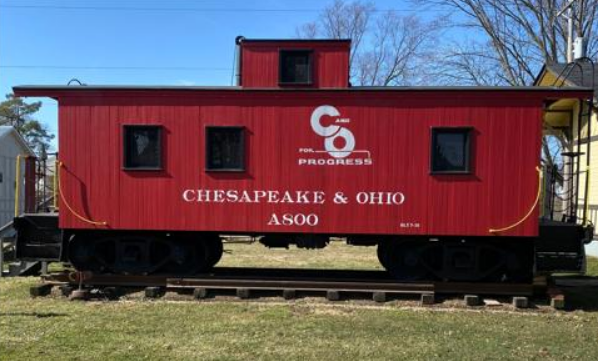
The caboose at the Historical Village in Weaver Park represents a little piece of Americana that has largely disappeared from today’s modern landscape.
The bright red train caboose resting there is more than a photo opportunity — it is a reminder of a time when railroads crisscrossed America’s countryside and cities, serving as a primary mode of transportation. In the early 20th century, the caboose — typically painted red, often depicted with a lantern hanging from its side or a brakeman waving from the rear platform — followed at the end of nearly every freight train.
While railroads remain vital for transporting goods across the country, the traditional caboose has disappeared from the rails, its duties now automated through modern technology.
Rescued from Salvage
The caboose at Weaver Park was built in 1930 and served faithfully until 1969, when the Chesapeake and Ohio Railway (C&O) removed it from service and ordered it dismantled. Fortunately, members of what was then the Northwest Franklin County Historical Society intervened just in time.
In a Sept. 21, 1972 letter to then HOHS president Bob King, a C&O vice president offered the society one “secondhand C&O caboose, No. A-800, located in Raceland, Kentucky … at no charge,” provided it was removed from railroad property at no cost to the company. Although the caboose was technically free, the historical society paid $1 to establish a clear chain of ownership.
The C&O - which later became part of CSX Transportation - agreed to transport the caboose to Columbus at no charge. From there, however, the society faced the challenge of moving the dilapidated railcar to Weaver Park from a yard on Neil Avenue.
On Nov. 30, 1972, the caboose was loaded onto a lowboy trailer and transported to Hilliard. The move cost $1,451 - a substantial sum at the time - generously paid by society member Lester T. Porter.
A Symbol of Hilliard’s Railroad Roots
The caboose was acquired to help illustrate Hilliard’s deep railroad history and to complement the historic depot already relocated to Weaver Park. That depot once stood along Center Street, where trains regularly stopped.
Hilliard itself was founded in 1853 as a railroad stop at Center and Main streets by John Reed Hilliard. Originally called Hilliard’s Station, the “Station” was eventually dropped, and the community was known simply as Hilliards — without an apostrophe — well into the mid-20th century. The name officially became Hilliard after the 1960 U.S. Census elevated the community from a village to a city when its population surpassed 5,000 residents.
Restoring a Community
Treasure Before the caboose arrived, volunteers laid a section of rails and ties to receive it. Over the next two years, members worked diligently to restore the aging railcar. They applied a white base coat to cover peeling paint, repaired the wood frame and interior cabin, and restored or replaced rusted ladders and steps — all at no cost beyond materials and supplies.
In July 1974, just one week before the opening of the Franklin County Fair, volunteers painted the caboose its now-iconic bright red.
Since then, members of the Hilliard Ohio Historical Society have continued to maintain the caboose, replacing vandalized windows and installing a new roof in 2001 to ensure its preservation for future generations. New siding was added in June of 2022.
Living History
Today, the caboose remains one of the most popular attractions at the Historical Village. During school tours, docents explain what life was like aboard a working caboose — where the brakeman ate his meals, slept, and carried out his duties.
The annual Heritage Day celebration in September highlights the caboose and Hilliard’s railroad legacy. In October the caboose is decorated as one of our “haunted” attractions during our family-friendly Haunted Village event.
Though no longer riding the rails, Caboose No. A-800 continues its journey as a living piece of local history — a bright red reminder of the era that quite literally put Hilliard on the map.
Train enthusiasts and visitors may tour the caboose whenever the Historical Village is open or schedule a private tour by appointment by calling 614-876-5880. Donations are appreciated for special arrangements.
Thanks to the foresight and dedication of local volunteers more than 50 years ago, this enduring symbol of America’s railroad heritage remains proudly on display in the heart of Old Hilliard.
Contributed by Bob Eggerichs
